Duration of Treatment
Depends on Condition
Days of Stay
Depends on Condition
Anesthesia
Depends on Condition
Cost
500 to 1000 USD
Dental Bridges Cost in India: Types, Procedure, Benefits and Best Treatment Options
Introduction: Dental Bridges Treatment in India
Are you looking for affordable dental bridges cost in India to replace missing teeth and restore your smile? India offers a range of dental restoration options, including porcelain-fused-to-metal (PFM), ceramic, zirconia, Maryland, and implant-supported dental bridges. The cost depends on the material used, the number of teeth being replaced, the condition of the supporting teeth, and the dental clinic selected.
A missing tooth can affect more than your appearance. It may make chewing difficult, change your speech, affect your confidence, and allow neighbouring teeth to move into the empty space. A dental bridge is a fixed dental restoration designed to fill the gap left by one or more missing teeth.
The dental bridge cost in India is approximately ₹9,000 to ₹45,000 for a conventional three-unit bridge, depending on the material and clinic. Premium materials and complex cases can cost more. A three-unit bridge generally includes two supporting crowns and one artificial tooth. These are indicative prices, not guaranteed quotations.
India is a popular destination for dental treatment because patients can access different materials, experienced dentists, dental laboratories, and a range of private and institutional dental facilities. International patients can also arrange consultations and treatment planning before travelling.
Peace Medical Tourism helps international patients coordinate dental consultations, treatment estimates, appointments, and travel-related arrangements in India, subject to individual requirements and availability.
What Is a Dental Bridge?
A dental bridge is a fixed dental prosthesis used to replace one or more missing teeth. It consists of an artificial tooth, called a pontic, supported by natural teeth or dental implants.
In a conventional dental bridge, the teeth on either side of the gap are prepared to receive crowns. The artificial tooth is connected to these crowns, creating a structure that bridges the missing-tooth space.
Unlike a removable partial denture, a conventional fixed dental bridge is cemented in place and is not intended to be removed by the patient.
According to the Indian Dental Association, traditional fixed bridges, resin-bonded bridges, and cantilever bridges are among the main types of dental bridges. The most suitable option depends on the position of the missing tooth, the condition of the neighbouring teeth, and the patient's oral health.
Dental Bridge Cost in India
The cost of a dental bridge in India varies according to the material, number of units, dentist's expertise, dental laboratory, and additional procedures required.
Estimated dental bridge prices
| Type of dental bridge | Estimated cost per unit |
|---|---|
| Metal dental bridge | ₹3,000–₹8,000 |
| Porcelain-fused-to-metal (PFM) bridge | ₹5,000–₹12,000 |
| All-ceramic dental bridge | ₹8,000–₹15,000 |
| Zirconia dental bridge | ₹12,000–₹25,000 |
| Maryland or resin-bonded bridge | ₹5,000–₹12,000 |
| Implant-supported bridge | ₹25,000–₹60,000 or more per unit in some treatment plans |
These are broad planning estimates, not fixed national tariffs. Implant-supported bridge prices may be quoted differently by clinics, and the implant fixtures, abutments, surgery, and other components may be charged separately. Ask for an itemised quotation before treatment.
What is the cost of a three-unit dental bridge?
A three-unit bridge is commonly used to replace one missing tooth when the two neighbouring teeth can support the restoration.
| Material | Approximate total for a three-unit bridge |
|---|---|
| Metal | ₹9,000–₹24,000 |
| PFM | ₹15,000–₹36,000 |
| All-ceramic | ₹24,000–₹45,000 |
| Zirconia | ₹36,000–₹75,000 |
The final amount may be higher if the patient requires root canal treatment, gum treatment, temporary restorations, tooth build-ups, or other procedures.
Why are dental bridges priced per unit?
Dental bridges are often quoted per unit rather than per missing tooth. Each supporting crown and each replacement tooth generally counts as one unit.
For example, a three-unit bridge replacing one missing tooth usually consists of:
- One crown on the supporting tooth on the left.
- One artificial tooth filling the gap.
- One crown on the supporting tooth on the right.
A four-unit bridge may include two supporting crowns and two replacement teeth, although the design depends on the clinical situation. Always confirm how many units the quotation includes.
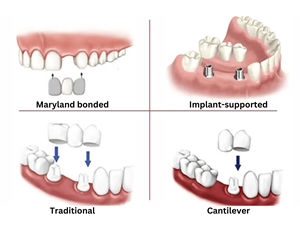
Types of Dental Bridges Available in India
Dentists offer several types of dental bridges. The choice depends on the location of the missing tooth, the health of the adjacent teeth, bite pressure, cosmetic expectations, and budget.
1. Traditional fixed dental bridge
A traditional fixed bridge is one of the most commonly used options. It is generally supported by crowns placed on the natural teeth on both sides of the gap.
The supporting teeth are prepared to accommodate the crowns, and the artificial tooth is connected between them.
Advantages:
- Replaces missing teeth with a fixed restoration.
- Restores chewing function and the appearance of the smile.
- Does not require implant surgery.
- Can often be completed over a relatively short treatment period.
Limitations:
- Supporting teeth usually need to be reshaped.
- The supporting teeth must be strong enough to carry the bridge.
- Decay or gum disease around the supporting teeth can compromise the restoration.
This option may be suitable when the neighbouring teeth already need crowns or when implants are not appropriate for the patient.
2. Porcelain-fused-to-metal (PFM) dental bridge
A PFM bridge has a metal framework covered with tooth-coloured porcelain. It combines the strength of a metal substructure with a more natural appearance than a fully metal restoration.
PFM bridges are often considered for both front and back teeth, depending on the case.
Advantages:
- A balance between cost, strength, and appearance.
- Suitable for many routine restorative cases.
- Available through many dental clinics and laboratories.
Limitations:
- A dark metal margin may become visible near the gum line.
- Porcelain can chip in some circumstances.
- The appearance may be less natural than some premium all-ceramic options.
The estimated cost is approximately ₹5,000–₹12,000 per unit, although clinic prices vary.
3. Zirconia dental bridge
Zirconia is a strong ceramic material used for crowns and bridges. It is available in different formulations designed to balance strength and appearance.
Zirconia may be considered for back teeth, where chewing forces are higher, and for selected front-tooth restorations where appearance is important.
Advantages:
- Metal-free appearance.
- Good strength when appropriately designed.
- Can provide natural-looking results.
- Does not have a conventional metal substructure.
Limitations:
- Usually costs more than many standard PFM bridges.
- Suitability depends on the bridge span, bite, and available space.
- Material choice and laboratory quality influence the final result.
The estimated cost is approximately ₹12,000–₹25,000 per unit. A three-unit zirconia bridge may therefore cost around ₹36,000–₹75,000.
4. All-ceramic dental bridge
All-ceramic bridges are made without a metal framework. They are selected when a tooth-coloured restoration is important, particularly in visible areas.
Different ceramics have different strength characteristics. Not every ceramic material is suitable for every bridge design, especially for long spans or areas subject to high bite pressure.
Advantages:
- Natural-looking appearance.
- No metal framework.
- Can be suitable for selected front-tooth restorations.
Limitations:
- Material choice must match the location and function of the teeth.
- Some designs may be less suitable for high-load or long-span restorations.
- Cost varies by ceramic type and laboratory technique.
Estimated cost: ₹8,000–₹15,000 per unit.
5. Maryland or resin-bonded dental bridge
A Maryland bridge uses a replacement tooth attached to small wings that are bonded to the back of neighbouring teeth. It usually requires less removal of natural tooth structure than a traditional bridge.
It is often considered for selected front-tooth gaps when the neighbouring teeth are healthy and the bite conditions are favourable.
Advantages:
- Conservative preparation in suitable cases.
- May preserve more of the neighbouring teeth.
- Often avoids implant surgery.
- Can be a useful option for selected front teeth.
Limitations:
- The bonded wings may detach.
- It may not be suitable for areas with heavy chewing forces.
- The shape and position of the teeth affect whether it can be used.
- Estimated cost: ₹5,000–₹12,000 per unit, depending on the design and clinic.
6. Cantilever dental bridge
A cantilever bridge is supported by one or more teeth on only one side of the missing-tooth space. It may be considered in selected situations, particularly where the bite forces are limited.
It is not suitable for every missing tooth. Because the support is on one side, the bridge can create additional leverage on the supporting tooth.
The dentist will assess the location of the gap, bite forces, and strength of the supporting tooth before recommending this design.
7. Implant-supported dental bridge
An implant-supported bridge is attached to dental implants rather than relying solely on natural teeth for support.
Dental implants are placed in the jawbone and act as artificial tooth roots. Once the implants are ready to support the restoration, a bridge can be attached to them.
This approach may be suitable for patients missing several adjacent teeth. The number and position of implants depend on the amount of available bone, the length of the bridge, bite forces, and the overall treatment plan.
Advantages:
- Does not require crowns on otherwise healthy neighbouring teeth.
- Can replace several missing teeth.
- Provides a fixed restoration.
- May help limit bone loss associated with the absence of natural tooth roots, although bone changes can still occur.
Limitations:
- Requires implant surgery.
- Treatment may take longer than a conventional bridge.
- Bone grafting or other preparatory procedures may be necessary.
- The total cost is usually higher than a conventional tooth-supported bridge.
The total price should clearly separate the implant fixtures, surgery, abutments, bridge, scans, and any additional treatment.
Dental Bridge Cost by City in India
Dental bridge prices can vary between cities, clinics, and dental laboratories. The following are broad estimates for planning rather than verified quotations from specific providers.
| City | Approximate cost per unit for common bridge materials |
|---|---|
| Delhi and NCR | ₹3,000–₹15,000+ |
| Mumbai | ₹3,000–₹15,000+ |
| Bengaluru | ₹3,000–₹15,000+ |
| Chennai | ₹2,500–₹15,000+ |
| Hyderabad | ₹3,000–₹15,000+ |
| Kolkata | ₹2,500–₹12,000+ |
| Pune | ₹3,000–₹15,000+ |
| Ahmedabad | ₹2,500–₹12,000+ |
| Jaipur | ₹2,000–₹12,000+ |
| Lucknow | ₹2,000–₹12,000+ |
These ranges are not directly comparable unless the material, number of units, laboratory standards, and included services are the same. Premium zirconia restorations and implant-supported bridges can exceed the upper figures shown.
Patients should compare the proposed treatment and the dentist's qualifications rather than choosing a clinic on price alone.
Factors Affecting Dental Bridge Cost in India
Several factors determine the final treatment cost.
1. Material used
Metal and PFM restorations are often more economical than premium ceramic or zirconia options. The material must be selected according to the position of the tooth, bite forces, cosmetic requirements, and bridge design.
2. Number of units
A bridge replacing one tooth may require three units. Replacing two adjacent teeth may require a longer bridge, depending on the support available. More units usually increase the total cost.
3. Condition of supporting teeth
If the supporting teeth have decay, fractures, large fillings, or infection, additional treatment may be necessary before the bridge can be placed.
4. Root canal treatment
A supporting tooth with an infected or damaged nerve may need root canal treatment if the dentist determines that the tooth can be preserved. This is an additional cost and is not required for every dental bridge.
5. Gum health
Gum disease should be assessed and managed before definitive bridge placement. Inflamed gums, bone loss, or loose supporting teeth may affect the suitability and longevity of the restoration.
6. Dentist's expertise
Complex restorations may require a dentist with additional training in prosthodontics or restorative dentistry. Clinical planning, bite adjustment, and the precision of the final fit are important to long-term results.
7. Dental laboratory and technology
Digital scans, computer-aided design and manufacturing (CAD/CAM), laboratory expertise, and the chosen material can influence cost and turnaround time.
8. Temporary bridge
Some patients need a temporary restoration while the permanent bridge is being made. Ask whether this is included in the quoted price.
9. Additional procedures
Tooth build-ups, extractions, periodontal treatment, or implant-related procedures may increase the total cost. A written treatment plan should identify these charges before treatment begins.
Benefits of Dental Bridges
Dental bridges offer several potential benefits when correctly planned and maintained.
Restores the appearance of the smile
A tooth-coloured bridge can fill a visible gap and help create a more complete smile.
Improves chewing function
Replacing missing teeth can help restore the ability to chew comfortably, depending on the number and position of teeth replaced.
May improve speech
In selected cases, replacing missing teeth can help with pronunciation and speech clarity.
Provides a fixed solution
A conventional fixed bridge remains in place during normal use and does not need to be removed daily like a removable denture.
Avoids implant surgery in conventional cases
A tooth-supported bridge can replace a missing tooth without placing a dental implant. This may be useful when implant surgery is not suitable or preferred.
Offers several material choices
Patients can discuss metal, PFM, ceramic, and zirconia restorations according to their clinical needs and budget.
.
Dental Bridge vs Dental Implant
A dental bridge and a dental implant can both replace missing teeth, but they work differently.
| Feature | Tooth-supported bridge | Dental implant |
|---|---|---|
| Support | Natural teeth next to the gap | Implant placed in the jawbone |
| Treatment time | Often shorter when no additional treatment is needed | Usually longer because healing may be required |
| Surgery | Usually no implant surgery | Implant surgery is required |
| Adjacent teeth | Often need preparation for crowns | Usually do not need preparation solely to support the implant |
| Bone assessment | Important for overall oral health | Particularly important for implant planning |
| Cost | Often lower initially for a conventional bridge | Usually higher when implant surgery and restoration are included |
| Maintenance | Cleaning under the bridge and around supporting teeth | Cleaning around the implant and restoration |
| Suitability | Depends on the strength of supporting teeth and bridge design | Depends on bone, gum health, medical history, and other factors |
There is no single option that is best for everyone. A conventional bridge may be appropriate when neighbouring teeth already need crowns or when an implant is unsuitable. An implant may be worth considering when preserving healthy adjacent teeth is a priority.
Ask your dentist to explain the benefits, limitations, expected maintenance, and full cost of each option.
Why Choose Peace Medical Tourism for Dental Treatment in India?
Peace Medical Tourism, operated by Peace Health Care Pvt Ltd in New Delhi, assists international patients with treatment coordination in India.
Our support may include:
- Coordinating initial dental enquiries and medical-record sharing.
- Helping patients seek consultations with suitable dental providers.
- Requesting treatment plans and cost estimates from providers.
- Assisting with appointment scheduling.
- Providing guidance on travel and accommodation arrangements, subject to availability and the agreed services.
- Helping patients understand the proposed treatment schedule and follow-up requirements.
Treatment recommendations, clinical outcomes, and final prices are determined by the treating dental provider. Patients should review the dentist's credentials and written treatment plan before proceeding.
Contact Peace Medical Tourism
Website: https://peacemedicaltourism.com
Email: treatmentquery@gmail.com
WhatsApp/Viber: +91 9582708782
Contact us to enquire about dental bridge treatment options and request an estimate based on your dental records.
Who Needs Dental Bridge Treatment?
A dentist may recommend a bridge for someone who has lost one or more teeth due to:
- Tooth decay that cannot be treated with a filling or crown alone.
- Gum disease that has led to tooth loss.
- Dental trauma or an accident.
- A fractured tooth that cannot be restored.
- Congenitally missing teeth.
- Previous dental extraction.
A dental bridge may restore the gap, improve chewing, and help maintain the position of remaining teeth. However, a bridge is not automatically the best choice for every patient with missing teeth.
The dentist will examine the remaining teeth, gums, bite, and jawbone and discuss alternatives such as a dental implant or removable partial denture.
Symptoms and Problems Caused by Missing Teeth
Missing teeth do not always cause pain, but they can create functional and cosmetic problems.
Difficulty chewing
A missing tooth can make it harder to chew certain foods, particularly when several teeth are missing or the gap is in a heavily used chewing area.
Changes in speech
Depending on which teeth are missing, a gap may affect the pronunciation of some sounds.
Changes in appearance
Missing front teeth can affect a person's smile and confidence. A well-planned bridge can restore the visible tooth structure.
Movement of neighbouring teeth
Adjacent teeth may drift into an empty space over time. This can affect the bite and make future restoration more complicated.
Uneven chewing forces
Patients may favour one side of the mouth when chewing. This can create discomfort or place extra load on other teeth in some cases.
Not every patient develops all these problems. A dental examination can help determine whether a bridge or another treatment is appropriate.
Dental bridges are widely used, but they have limitations and potential complications.
-
Decay around supporting teeth: Food and plaque can collect around bridge margins if cleaning is inadequate.
-
Gum disease: Inflammation or bone loss around supporting teeth can affect the bridge's stability.
-
Sensitivity: Prepared teeth may experience temporary sensitivity, and some teeth may develop complications requiring further treatment.
-
Damage or fracture: The bridge or its porcelain covering may chip, crack, or break.
-
Loosening: Cement may fail, or the bridge may become loose.
-
Food trapping: Poor fit, gum changes, or difficulty cleaning underneath the pontic may lead to food accumulation.
-
Bite discomfort: The bridge may require adjustment if the bite feels uneven.
-
Supporting-tooth damage: A conventional bridge places demands on the teeth used for support.
The dentist should explain the risks specific to the proposed bridge design and the alternatives available.
Preparation for Dental Bridges in India
Proper preparation before dental bridge treatment helps ensure a good fit, comfortable treatment, and better long-term results. Before placing a dental bridge, the dentist examines the teeth, gums, and bite to determine the most suitable restoration.
How to Prepare for Dental Bridge Treatment
1. Schedule a dental consultation: Visit a qualified dentist to assess the missing tooth, neighbouring teeth, gum health, and available treatment options.
2. Complete the required investigations: Dental X-rays, photographs, impressions, or digital scans may be required to evaluate the supporting teeth and plan the bridge.
3. Treat existing dental problems: Tooth decay, gum disease, or dental infections should be treated before the final bridge is placed. Root canal treatment may be needed if a supporting tooth has nerve damage.
4. Discuss the bridge material and cost: Ask your dentist about PFM, ceramic, zirconia, or other suitable materials. Confirm the number of units, total cost, temporary bridge charges, and any additional procedures.
5. Maintain good oral hygiene: Brush twice daily with fluoride toothpaste and clean between your teeth. Healthy gums help support a successful restoration.
6. Share your medical history: Inform your dentist about medical conditions, allergies, medications, and previous dental treatments. Do not stop prescribed medicines unless your treating clinician advises you to do so.
7. Follow pre-treatment instructions: Conventional dental bridge preparation is usually performed under local anaesthesia and generally does not require fasting. Follow the clinic's specific instructions if sedation or another procedure is planned.
8. Plan your appointments: A conventional bridge often requires two or more visits. International patients should confirm the expected treatment duration and follow-up schedule before travelling to India.
Important: A conventional dental bridge may require reshaping the supporting teeth. Your dentist should explain the benefits, risks, and alternatives, including a dental implant or removable partial denture, before treatment begins.
Dental Bridge Procedure in India
The process depends on the type of bridge, the condition of the teeth, and whether any preparatory treatment is required.
Step 1: Dental consultation
The dentist examines the missing-tooth space, surrounding teeth, gums, bite, and oral hygiene. The patient's medical history and treatment preferences are also reviewed.
The dentist discusses possible treatments, such as a conventional bridge, Maryland bridge, implant-supported bridge, or removable denture.
Step 2: Dental X-rays or scans
X-rays or other imaging may be required to assess the supporting teeth, roots, and surrounding bone. Digital scans or dental impressions are used to record the shape of the teeth.
The type of imaging depends on the clinical situation. A cone-beam CT scan may be considered when implant planning requires three-dimensional assessment.
Step 3: Preparing the supporting teeth
For a conventional bridge, the dentist reshapes the supporting teeth so that crowns can fit over them. Local anaesthesia is usually used to make the procedure more comfortable.
This preparation is generally not the same for every bridge type. A resin-bonded bridge may require much less tooth preparation.
Step 4: Taking impressions or digital scans
The dentist records the shape and position of the teeth so the dental laboratory can manufacture a bridge that fits the gap and matches the bite.
The dentist may also record the desired shade to achieve a suitable appearance.
Step 5: Temporary bridge placement
A temporary bridge may be placed while the permanent restoration is being manufactured. It helps protect prepared teeth and maintain appearance and function during the waiting period.
Patients should follow the dentist's instructions for cleaning and avoiding sticky or very hard foods while wearing a temporary bridge.
Step 6: Fabrication of the permanent bridge
The dental laboratory creates the restoration using the chosen material. The time required depends on the material, laboratory process, and complexity of the case.
Step 7: Fitting and cementation
At the next appointment, the dentist checks the fit, bite, colour, and contact with the neighbouring teeth. Adjustments may be made before the bridge is permanently cemented.
Step 8: Follow-up
The dentist checks the restoration and surrounding gums and explains how to clean underneath the artificial tooth. Follow-up is important to identify problems early.
How Long Does Dental Bridge Treatment Take?
- A conventional dental bridge can often be completed over two or more appointments, commonly within about one to two weeks when no additional treatment is needed. The exact timeline depends on the clinic, laboratory, material, and complexity of the case.
- Treatment may take longer if the patient requires root canal treatment, gum therapy, extractions, or other procedures before the bridge can be placed.
- Implant-supported bridges usually require a longer treatment plan because the implants need time to integrate with the jawbone. Some patients also need bone grafting or other preparatory treatment.
- International patients should obtain a written timeline from the treating dentist before booking flights or accommodation.
Aftercare Following Dental Bridge Placement
Proper cleaning is essential to protect the supporting teeth and gums.
Brush carefully
Brush twice daily with fluoride toothpaste, paying attention to the gum line and areas around the bridge.
Clean underneath the artificial tooth
The pontic creates an area where food and plaque can collect. Special bridge floss, floss threaders, or interdental brushes may help clean underneath it. The dentist should demonstrate the correct technique.
Avoid excessive force
Avoid biting hard objects and be cautious with very sticky foods, particularly during the temporary-bridge stage or if the dentist gives specific restrictions.
Attend regular dental reviews
Routine dental visits allow the dentist to check the bridge, supporting teeth, gums, and bite.
Seek help for warning signs
Contact the dentist if the bridge becomes loose, the bite changes, pain persists, the gums bleed or swell, or a bad taste develops around the restoration. A loose bridge should not be repaired with household glue.
Dental Bridges for International Patients in India
India offers a variety of dental clinics and restorative treatment options for international patients. Before travelling, patients should compare clinics based on clinical qualifications, treatment planning, material transparency, hygiene standards, and aftercare arrangements.
A useful process is to:
- Share recent dental records and available X-rays for an initial review.
- Request an assessment by a qualified dentist or prosthodontist where appropriate.
- Ask for a written treatment plan and itemised cost estimate.
- Confirm the bridge material, number of units, and whether temporary restorations are included.
- Ask how many visits are required and how long the patient should stay.
- Discuss what follow-up is needed after returning home.
- Keep copies of the treatment records, invoices, and material information.
An online estimate cannot replace an in-person dental examination. The dentist may revise the treatment plan after checking the teeth, gums, and bite.
Success Rate of Dental Bridges in India
Dental bridge treatment in India generally has a high success rate when the bridge is properly designed, fitted by a qualified dentist, and supported by healthy teeth and gums. The outcome depends on the type of bridge, oral hygiene, bite pressure, and the condition of the supporting teeth.
A conventional dental bridge can often last 5–15 years or longer with appropriate care. However, its lifespan is not guaranteed, and complications such as tooth decay, gum disease, loosening, or damage to the supporting teeth may occur.
Estimated Dental Bridge Survival Rate
Follow-up period
Estimated survival rate
3 years 94–95%
5 years 90–91%
10 years 79–82%
These estimates are based on a review of studies of all-ceramic dental bridges and may not apply to every bridge type or patient.
Factors That Improve Success
- Choosing the right bridge type and material.
- Maintaining healthy supporting teeth and gums.
- Brushing twice daily and cleaning underneath the bridge.
- Avoiding excessive biting pressure and chewing very hard objects.
- Attending regular dental check-ups and professional cleaning.
How Long Does Dental Bridge Treatment Take?
- A conventional dental bridge can often be completed over two or more appointments, commonly within about one to two weeks when no additional treatment is needed. The exact timeline depends on the clinic, laboratory, material, and complexity of the case.
- Treatment may take longer if the patient requires root canal treatment, gum therapy, extractions, or other procedures before the bridge can be placed.
- Implant-supported bridges usually require a longer treatment plan because the implants need time to integrate with the jawbone. Some patients also need bone grafting or other preparatory treatment.
- International patients should obtain a written timeline from the treating dentist before booking flights or accommodation.
Important: The success rate varies with the patient's dental condition, the bridge design, and the dentist's assessment. A consultation is necessary to estimate the likely outcome for an individual patient.
Frequently Asked Questions About Dental Bridges Cost in India
1. What is the cost of a dental bridge in India?
A conventional three-unit bridge may cost approximately ₹9,000–₹45,000, depending on the material and clinic. Premium zirconia bridges and complex restorations may cost more.
2. What is the cost of a zirconia dental bridge in India?
Zirconia may cost around ₹12,000–₹25,000 per unit. A three-unit bridge may therefore cost approximately ₹36,000–₹75,000. Prices vary between providers.
3. How much does a PFM dental bridge cost in India?
A porcelain-fused-to-metal bridge may cost approximately ₹5,000–₹12,000 per unit. A three-unit bridge may cost ₹15,000–₹36,000.
4. How much does a bridge for one missing tooth cost?
A conventional bridge replacing one tooth often uses three units: two supporting crowns and one artificial tooth. The total depends on the material, clinic, and any additional treatment required.
5. Is a dental bridge permanent?
A fixed dental bridge is cemented in place and is not intended to be removed by the patient. However, it may need repair or replacement over time.
6. Is dental bridge treatment painful?
Local anaesthesia is generally used when preparing teeth for a conventional bridge. Some sensitivity or gum discomfort may occur afterward. Persistent or severe pain should be assessed by the dentist.
7. How many days are needed for a dental bridge?
A conventional bridge may be completed over two or more visits, often within one to two weeks if no additional procedures are required. The dentist should confirm the timeline for your case.
8. Is a dental bridge better than a dental implant?
Neither is best for every patient. A bridge may be quicker and less expensive initially, while an implant can avoid preparing healthy neighbouring teeth. The appropriate choice depends on oral health, bone condition, budget, and personal preference.
9. Can a dental bridge replace three missing teeth?
It may be possible, but the suitability depends on the location of the gap, the supporting teeth, and bite forces. An implant-supported bridge or another restoration may be more appropriate in some cases.
10. Can a dental bridge look natural?
Yes. Tooth-coloured materials such as ceramic and zirconia can provide natural-looking results when appropriately selected and designed. The final appearance also depends on shade matching, gum health, and the dentist's and laboratory's work.
11. Do supporting teeth need root canal treatment before a bridge?
No. Root canal treatment is not automatically required. It may be recommended if a supporting tooth has infection or nerve damage and can be preserved.
12. Can a dental bridge be placed if I have gum disease?
Gum disease should be assessed and managed before definitive bridge placement. Teeth with significant mobility or bone loss may not provide reliable support.
13. What is the difference between a crown and a bridge?
A crown covers an individual tooth to restore its shape and strength. A bridge replaces one or more missing teeth by connecting artificial teeth to supporting teeth or implants.
14. Does a dental bridge require special cleaning?
Yes. In addition to brushing, patients need to clean underneath the artificial tooth and around the bridge margins. A dentist can recommend appropriate flossing tools or interdental brushes.
15. Can a dental bridge become loose?
Yes. Cement failure, decay, damage, or changes in the supporting teeth can cause loosening. Contact a dentist promptly if the bridge moves or comes off.
16. Are dental bridges suitable for front teeth?
They can be suitable for front teeth. Ceramic, zirconia, and selected resin-bonded designs may be considered depending on the bite, neighbouring teeth, and cosmetic requirements.
17. Are dental bridges suitable for back teeth?
They may be suitable for back teeth, but the dentist must consider chewing forces and the strength of the supporting teeth. Material and design are particularly important in these areas.
18. Is an implant-supported bridge more expensive?
It often costs more because implant fixtures, surgery, abutments, and the bridge itself may all contribute to the total. Ask for an itemised estimate that clearly states what is included.
19. Can international patients get dental bridges in India?
Yes. International patients can enquire with Indian dental providers and share records for preliminary assessment. An in-person examination is still needed to confirm suitability and the final cost.
20. How can I get a dental bridge cost estimate from Peace Medical Tourism?
Contact Peace Medical Tourism through the website, email, or WhatsApp/Viber number listed above. Share the available dental records and explain which teeth are missing. A treating dentist will need to assess your case before confirming the treatment plan and price.
Conclusion
Dental bridges can help replace missing teeth, restore chewing function, and improve the appearance of the smile. India offers several options, including metal, PFM, ceramic, zirconia, Maryland, cantilever, and implant-supported bridges.
The estimated dental bridge cost in India starts at around ₹9,000 for some three-unit conventional bridges, while premium materials and implant-supported options can cost substantially more. The best choice depends on the condition of the supporting teeth, the position of the missing tooth, the material, and the patient's long-term oral health goals.
Before choosing a clinic, request a written treatment plan, confirm the total number of units, check whether additional procedures are required, and discuss aftercare. A properly planned bridge, combined with good oral hygiene and regular dental reviews, can provide a useful long-term restoration.
Peace Medical Tourism can help international patients coordinate dental enquiries and treatment planning in India. Contact our team to request information about available dental bridge options and estimated costs.
Top Doctors
Sorry, There is nothing to show!Come back soon.
Top Hospitals
















DENTAL BRIDGES
Duration of Treatment
Depends on Condition
Days of Stay
Depends on Condition
Anesthesia
Depends on Condition
Cost
500 to 1000 USD
Dental Bridges Cost in India: Types, Procedure, Benefits and Best Treatment Options
Introduction: Dental Bridges Treatment in India
Are you looking for affordable dental bridges cost in India to replace missing teeth and restore your smile? India offers a range of dental restoration options, including porcelain-fused-to-metal (PFM), ceramic, zirconia, Maryland, and implant-supported dental bridges. The cost depends on the material used, the number of teeth being replaced, the condition of the supporting teeth, and the dental clinic selected.
A missing tooth can affect more than your appearance. It may make chewing difficult, change your speech, affect your confidence, and allow neighbouring teeth to move into the empty space. A dental bridge is a fixed dental restoration designed to fill the gap left by one or more missing teeth.
The dental bridge cost in India is approximately ₹9,000 to ₹45,000 for a conventional three-unit bridge, depending on the material and clinic. Premium materials and complex cases can cost more. A three-unit bridge generally includes two supporting crowns and one artificial tooth. These are indicative prices, not guaranteed quotations.
India is a popular destination for dental treatment because patients can access different materials, experienced dentists, dental laboratories, and a range of private and institutional dental facilities. International patients can also arrange consultations and treatment planning before travelling.
Peace Medical Tourism helps international patients coordinate dental consultations, treatment estimates, appointments, and travel-related arrangements in India, subject to individual requirements and availability.
What Is a Dental Bridge?
A dental bridge is a fixed dental prosthesis used to replace one or more missing teeth. It consists of an artificial tooth, called a pontic, supported by natural teeth or dental implants.
In a conventional dental bridge, the teeth on either side of the gap are prepared to receive crowns. The artificial tooth is connected to these crowns, creating a structure that bridges the missing-tooth space.
Unlike a removable partial denture, a conventional fixed dental bridge is cemented in place and is not intended to be removed by the patient.
According to the Indian Dental Association, traditional fixed bridges, resin-bonded bridges, and cantilever bridges are among the main types of dental bridges. The most suitable option depends on the position of the missing tooth, the condition of the neighbouring teeth, and the patient's oral health.
Dental Bridge Cost in India
The cost of a dental bridge in India varies according to the material, number of units, dentist's expertise, dental laboratory, and additional procedures required.
Estimated dental bridge prices
| Type of dental bridge | Estimated cost per unit |
|---|---|
| Metal dental bridge | ₹3,000–₹8,000 |
| Porcelain-fused-to-metal (PFM) bridge | ₹5,000–₹12,000 |
| All-ceramic dental bridge | ₹8,000–₹15,000 |
| Zirconia dental bridge | ₹12,000–₹25,000 |
| Maryland or resin-bonded bridge | ₹5,000–₹12,000 |
| Implant-supported bridge | ₹25,000–₹60,000 or more per unit in some treatment plans |
These are broad planning estimates, not fixed national tariffs. Implant-supported bridge prices may be quoted differently by clinics, and the implant fixtures, abutments, surgery, and other components may be charged separately. Ask for an itemised quotation before treatment.
What is the cost of a three-unit dental bridge?
A three-unit bridge is commonly used to replace one missing tooth when the two neighbouring teeth can support the restoration.
| Material | Approximate total for a three-unit bridge |
|---|---|
| Metal | ₹9,000–₹24,000 |
| PFM | ₹15,000–₹36,000 |
| All-ceramic | ₹24,000–₹45,000 |
| Zirconia | ₹36,000–₹75,000 |
The final amount may be higher if the patient requires root canal treatment, gum treatment, temporary restorations, tooth build-ups, or other procedures.
Why are dental bridges priced per unit?
Dental bridges are often quoted per unit rather than per missing tooth. Each supporting crown and each replacement tooth generally counts as one unit.
For example, a three-unit bridge replacing one missing tooth usually consists of:
- One crown on the supporting tooth on the left.
- One artificial tooth filling the gap.
- One crown on the supporting tooth on the right.
A four-unit bridge may include two supporting crowns and two replacement teeth, although the design depends on the clinical situation. Always confirm how many units the quotation includes.
Types of Dental Bridges Available in India
Dentists offer several types of dental bridges. The choice depends on the location of the missing tooth, the health of the adjacent teeth, bite pressure, cosmetic expectations, and budget.
1. Traditional fixed dental bridge
A traditional fixed bridge is one of the most commonly used options. It is generally supported by crowns placed on the natural teeth on both sides of the gap.
The supporting teeth are prepared to accommodate the crowns, and the artificial tooth is connected between them.
Advantages:
- Replaces missing teeth with a fixed restoration.
- Restores chewing function and the appearance of the smile.
- Does not require implant surgery.
- Can often be completed over a relatively short treatment period.
Limitations:
- Supporting teeth usually need to be reshaped.
- The supporting teeth must be strong enough to carry the bridge.
- Decay or gum disease around the supporting teeth can compromise the restoration.
This option may be suitable when the neighbouring teeth already need crowns or when implants are not appropriate for the patient.
2. Porcelain-fused-to-metal (PFM) dental bridge
A PFM bridge has a metal framework covered with tooth-coloured porcelain. It combines the strength of a metal substructure with a more natural appearance than a fully metal restoration.
PFM bridges are often considered for both front and back teeth, depending on the case.
Advantages:
- A balance between cost, strength, and appearance.
- Suitable for many routine restorative cases.
- Available through many dental clinics and laboratories.
Limitations:
- A dark metal margin may become visible near the gum line.
- Porcelain can chip in some circumstances.
- The appearance may be less natural than some premium all-ceramic options.
The estimated cost is approximately ₹5,000–₹12,000 per unit, although clinic prices vary.
3. Zirconia dental bridge
Zirconia is a strong ceramic material used for crowns and bridges. It is available in different formulations designed to balance strength and appearance.
Zirconia may be considered for back teeth, where chewing forces are higher, and for selected front-tooth restorations where appearance is important.
Advantages:
- Metal-free appearance.
- Good strength when appropriately designed.
- Can provide natural-looking results.
- Does not have a conventional metal substructure.
Limitations:
- Usually costs more than many standard PFM bridges.
- Suitability depends on the bridge span, bite, and available space.
- Material choice and laboratory quality influence the final result.
The estimated cost is approximately ₹12,000–₹25,000 per unit. A three-unit zirconia bridge may therefore cost around ₹36,000–₹75,000.
4. All-ceramic dental bridge
All-ceramic bridges are made without a metal framework. They are selected when a tooth-coloured restoration is important, particularly in visible areas.
Different ceramics have different strength characteristics. Not every ceramic material is suitable for every bridge design, especially for long spans or areas subject to high bite pressure.
Advantages:
- Natural-looking appearance.
- No metal framework.
- Can be suitable for selected front-tooth restorations.
Limitations:
- Material choice must match the location and function of the teeth.
- Some designs may be less suitable for high-load or long-span restorations.
- Cost varies by ceramic type and laboratory technique.
Estimated cost: ₹8,000–₹15,000 per unit.
5. Maryland or resin-bonded dental bridge
A Maryland bridge uses a replacement tooth attached to small wings that are bonded to the back of neighbouring teeth. It usually requires less removal of natural tooth structure than a traditional bridge.
It is often considered for selected front-tooth gaps when the neighbouring teeth are healthy and the bite conditions are favourable.
Advantages:
- Conservative preparation in suitable cases.
- May preserve more of the neighbouring teeth.
- Often avoids implant surgery.
- Can be a useful option for selected front teeth.
Limitations:
- The bonded wings may detach.
- It may not be suitable for areas with heavy chewing forces.
- The shape and position of the teeth affect whether it can be used.
- Estimated cost: ₹5,000–₹12,000 per unit, depending on the design and clinic.
6. Cantilever dental bridge
A cantilever bridge is supported by one or more teeth on only one side of the missing-tooth space. It may be considered in selected situations, particularly where the bite forces are limited.
It is not suitable for every missing tooth. Because the support is on one side, the bridge can create additional leverage on the supporting tooth.
The dentist will assess the location of the gap, bite forces, and strength of the supporting tooth before recommending this design.
7. Implant-supported dental bridge
An implant-supported bridge is attached to dental implants rather than relying solely on natural teeth for support.
Dental implants are placed in the jawbone and act as artificial tooth roots. Once the implants are ready to support the restoration, a bridge can be attached to them.
This approach may be suitable for patients missing several adjacent teeth. The number and position of implants depend on the amount of available bone, the length of the bridge, bite forces, and the overall treatment plan.
Advantages:
- Does not require crowns on otherwise healthy neighbouring teeth.
- Can replace several missing teeth.
- Provides a fixed restoration.
- May help limit bone loss associated with the absence of natural tooth roots, although bone changes can still occur.
Limitations:
- Requires implant surgery.
- Treatment may take longer than a conventional bridge.
- Bone grafting or other preparatory procedures may be necessary.
- The total cost is usually higher than a conventional tooth-supported bridge.
The total price should clearly separate the implant fixtures, surgery, abutments, bridge, scans, and any additional treatment.
Dental Bridge Cost by City in India
Dental bridge prices can vary between cities, clinics, and dental laboratories. The following are broad estimates for planning rather than verified quotations from specific providers.
| City | Approximate cost per unit for common bridge materials |
|---|---|
| Delhi and NCR | ₹3,000–₹15,000+ |
| Mumbai | ₹3,000–₹15,000+ |
| Bengaluru | ₹3,000–₹15,000+ |
| Chennai | ₹2,500–₹15,000+ |
| Hyderabad | ₹3,000–₹15,000+ |
| Kolkata | ₹2,500–₹12,000+ |
| Pune | ₹3,000–₹15,000+ |
| Ahmedabad | ₹2,500–₹12,000+ |
| Jaipur | ₹2,000–₹12,000+ |
| Lucknow | ₹2,000–₹12,000+ |
These ranges are not directly comparable unless the material, number of units, laboratory standards, and included services are the same. Premium zirconia restorations and implant-supported bridges can exceed the upper figures shown.
Patients should compare the proposed treatment and the dentist's qualifications rather than choosing a clinic on price alone.
Factors Affecting Dental Bridge Cost in India
Several factors determine the final treatment cost.
1. Material used
Metal and PFM restorations are often more economical than premium ceramic or zirconia options. The material must be selected according to the position of the tooth, bite forces, cosmetic requirements, and bridge design.
2. Number of units
A bridge replacing one tooth may require three units. Replacing two adjacent teeth may require a longer bridge, depending on the support available. More units usually increase the total cost.
3. Condition of supporting teeth
If the supporting teeth have decay, fractures, large fillings, or infection, additional treatment may be necessary before the bridge can be placed.
4. Root canal treatment
A supporting tooth with an infected or damaged nerve may need root canal treatment if the dentist determines that the tooth can be preserved. This is an additional cost and is not required for every dental bridge.
5. Gum health
Gum disease should be assessed and managed before definitive bridge placement. Inflamed gums, bone loss, or loose supporting teeth may affect the suitability and longevity of the restoration.
6. Dentist's expertise
Complex restorations may require a dentist with additional training in prosthodontics or restorative dentistry. Clinical planning, bite adjustment, and the precision of the final fit are important to long-term results.
7. Dental laboratory and technology
Digital scans, computer-aided design and manufacturing (CAD/CAM), laboratory expertise, and the chosen material can influence cost and turnaround time.
8. Temporary bridge
Some patients need a temporary restoration while the permanent bridge is being made. Ask whether this is included in the quoted price.
9. Additional procedures
Tooth build-ups, extractions, periodontal treatment, or implant-related procedures may increase the total cost. A written treatment plan should identify these charges before treatment begins.
Benefits of Dental Bridges
Dental bridges offer several potential benefits when correctly planned and maintained.
Restores the appearance of the smile
A tooth-coloured bridge can fill a visible gap and help create a more complete smile.
Improves chewing function
Replacing missing teeth can help restore the ability to chew comfortably, depending on the number and position of teeth replaced.
May improve speech
In selected cases, replacing missing teeth can help with pronunciation and speech clarity.
Provides a fixed solution
A conventional fixed bridge remains in place during normal use and does not need to be removed daily like a removable denture.
Avoids implant surgery in conventional cases
A tooth-supported bridge can replace a missing tooth without placing a dental implant. This may be useful when implant surgery is not suitable or preferred.
Offers several material choices
Patients can discuss metal, PFM, ceramic, and zirconia restorations according to their clinical needs and budget.
.
Dental Bridge vs Dental Implant
A dental bridge and a dental implant can both replace missing teeth, but they work differently.
| Feature | Tooth-supported bridge | Dental implant |
|---|---|---|
| Support | Natural teeth next to the gap | Implant placed in the jawbone |
| Treatment time | Often shorter when no additional treatment is needed | Usually longer because healing may be required |
| Surgery | Usually no implant surgery | Implant surgery is required |
| Adjacent teeth | Often need preparation for crowns | Usually do not need preparation solely to support the implant |
| Bone assessment | Important for overall oral health | Particularly important for implant planning |
| Cost | Often lower initially for a conventional bridge | Usually higher when implant surgery and restoration are included |
| Maintenance | Cleaning under the bridge and around supporting teeth | Cleaning around the implant and restoration |
| Suitability | Depends on the strength of supporting teeth and bridge design | Depends on bone, gum health, medical history, and other factors |
There is no single option that is best for everyone. A conventional bridge may be appropriate when neighbouring teeth already need crowns or when an implant is unsuitable. An implant may be worth considering when preserving healthy adjacent teeth is a priority.
Ask your dentist to explain the benefits, limitations, expected maintenance, and full cost of each option.
Why Choose Peace Medical Tourism for Dental Treatment in India?
Peace Medical Tourism, operated by Peace Health Care Pvt Ltd in New Delhi, assists international patients with treatment coordination in India.
Our support may include:
- Coordinating initial dental enquiries and medical-record sharing.
- Helping patients seek consultations with suitable dental providers.
- Requesting treatment plans and cost estimates from providers.
- Assisting with appointment scheduling.
- Providing guidance on travel and accommodation arrangements, subject to availability and the agreed services.
- Helping patients understand the proposed treatment schedule and follow-up requirements.
Treatment recommendations, clinical outcomes, and final prices are determined by the treating dental provider. Patients should review the dentist's credentials and written treatment plan before proceeding.
Contact Peace Medical Tourism
Website: https://peacemedicaltourism.com
Email: treatmentquery@gmail.com
WhatsApp/Viber: +91 9582708782
Contact us to enquire about dental bridge treatment options and request an estimate based on your dental records.
symptoms
Who Needs Dental Bridge Treatment?
A dentist may recommend a bridge for someone who has lost one or more teeth due to:
- Tooth decay that cannot be treated with a filling or crown alone.
- Gum disease that has led to tooth loss.
- Dental trauma or an accident.
- A fractured tooth that cannot be restored.
- Congenitally missing teeth.
- Previous dental extraction.
A dental bridge may restore the gap, improve chewing, and help maintain the position of remaining teeth. However, a bridge is not automatically the best choice for every patient with missing teeth.
The dentist will examine the remaining teeth, gums, bite, and jawbone and discuss alternatives such as a dental implant or removable partial denture.
Symptoms and Problems Caused by Missing Teeth
Missing teeth do not always cause pain, but they can create functional and cosmetic problems.
Difficulty chewing
A missing tooth can make it harder to chew certain foods, particularly when several teeth are missing or the gap is in a heavily used chewing area.
Changes in speech
Depending on which teeth are missing, a gap may affect the pronunciation of some sounds.
Changes in appearance
Missing front teeth can affect a person's smile and confidence. A well-planned bridge can restore the visible tooth structure.
Movement of neighbouring teeth
Adjacent teeth may drift into an empty space over time. This can affect the bite and make future restoration more complicated.
Uneven chewing forces
Patients may favour one side of the mouth when chewing. This can create discomfort or place extra load on other teeth in some cases.
Not every patient develops all these problems. A dental examination can help determine whether a bridge or another treatment is appropriate.
risk factors
Dental bridges are widely used, but they have limitations and potential complications.
-
Decay around supporting teeth: Food and plaque can collect around bridge margins if cleaning is inadequate.
-
Gum disease: Inflammation or bone loss around supporting teeth can affect the bridge's stability.
-
Sensitivity: Prepared teeth may experience temporary sensitivity, and some teeth may develop complications requiring further treatment.
-
Damage or fracture: The bridge or its porcelain covering may chip, crack, or break.
-
Loosening: Cement may fail, or the bridge may become loose.
-
Food trapping: Poor fit, gum changes, or difficulty cleaning underneath the pontic may lead to food accumulation.
-
Bite discomfort: The bridge may require adjustment if the bite feels uneven.
-
Supporting-tooth damage: A conventional bridge places demands on the teeth used for support.
The dentist should explain the risks specific to the proposed bridge design and the alternatives available.
preparation
Preparation for Dental Bridges in India
Proper preparation before dental bridge treatment helps ensure a good fit, comfortable treatment, and better long-term results. Before placing a dental bridge, the dentist examines the teeth, gums, and bite to determine the most suitable restoration.
How to Prepare for Dental Bridge Treatment
1. Schedule a dental consultation: Visit a qualified dentist to assess the missing tooth, neighbouring teeth, gum health, and available treatment options.
2. Complete the required investigations: Dental X-rays, photographs, impressions, or digital scans may be required to evaluate the supporting teeth and plan the bridge.
3. Treat existing dental problems: Tooth decay, gum disease, or dental infections should be treated before the final bridge is placed. Root canal treatment may be needed if a supporting tooth has nerve damage.
4. Discuss the bridge material and cost: Ask your dentist about PFM, ceramic, zirconia, or other suitable materials. Confirm the number of units, total cost, temporary bridge charges, and any additional procedures.
5. Maintain good oral hygiene: Brush twice daily with fluoride toothpaste and clean between your teeth. Healthy gums help support a successful restoration.
6. Share your medical history: Inform your dentist about medical conditions, allergies, medications, and previous dental treatments. Do not stop prescribed medicines unless your treating clinician advises you to do so.
7. Follow pre-treatment instructions: Conventional dental bridge preparation is usually performed under local anaesthesia and generally does not require fasting. Follow the clinic's specific instructions if sedation or another procedure is planned.
8. Plan your appointments: A conventional bridge often requires two or more visits. International patients should confirm the expected treatment duration and follow-up schedule before travelling to India.
Important: A conventional dental bridge may require reshaping the supporting teeth. Your dentist should explain the benefits, risks, and alternatives, including a dental implant or removable partial denture, before treatment begins.
procedure
Dental Bridge Procedure in India
The process depends on the type of bridge, the condition of the teeth, and whether any preparatory treatment is required.
Step 1: Dental consultation
The dentist examines the missing-tooth space, surrounding teeth, gums, bite, and oral hygiene. The patient's medical history and treatment preferences are also reviewed.
The dentist discusses possible treatments, such as a conventional bridge, Maryland bridge, implant-supported bridge, or removable denture.
Step 2: Dental X-rays or scans
X-rays or other imaging may be required to assess the supporting teeth, roots, and surrounding bone. Digital scans or dental impressions are used to record the shape of the teeth.
The type of imaging depends on the clinical situation. A cone-beam CT scan may be considered when implant planning requires three-dimensional assessment.
Step 3: Preparing the supporting teeth
For a conventional bridge, the dentist reshapes the supporting teeth so that crowns can fit over them. Local anaesthesia is usually used to make the procedure more comfortable.
This preparation is generally not the same for every bridge type. A resin-bonded bridge may require much less tooth preparation.
Step 4: Taking impressions or digital scans
The dentist records the shape and position of the teeth so the dental laboratory can manufacture a bridge that fits the gap and matches the bite.
The dentist may also record the desired shade to achieve a suitable appearance.
Step 5: Temporary bridge placement
A temporary bridge may be placed while the permanent restoration is being manufactured. It helps protect prepared teeth and maintain appearance and function during the waiting period.
Patients should follow the dentist's instructions for cleaning and avoiding sticky or very hard foods while wearing a temporary bridge.
Step 6: Fabrication of the permanent bridge
The dental laboratory creates the restoration using the chosen material. The time required depends on the material, laboratory process, and complexity of the case.
Step 7: Fitting and cementation
At the next appointment, the dentist checks the fit, bite, colour, and contact with the neighbouring teeth. Adjustments may be made before the bridge is permanently cemented.
Step 8: Follow-up
The dentist checks the restoration and surrounding gums and explains how to clean underneath the artificial tooth. Follow-up is important to identify problems early.
How Long Does Dental Bridge Treatment Take?
- A conventional dental bridge can often be completed over two or more appointments, commonly within about one to two weeks when no additional treatment is needed. The exact timeline depends on the clinic, laboratory, material, and complexity of the case.
- Treatment may take longer if the patient requires root canal treatment, gum therapy, extractions, or other procedures before the bridge can be placed.
- Implant-supported bridges usually require a longer treatment plan because the implants need time to integrate with the jawbone. Some patients also need bone grafting or other preparatory treatment.
- International patients should obtain a written timeline from the treating dentist before booking flights or accommodation.
post procedure
Aftercare Following Dental Bridge Placement
Proper cleaning is essential to protect the supporting teeth and gums.
Brush carefully
Brush twice daily with fluoride toothpaste, paying attention to the gum line and areas around the bridge.
Clean underneath the artificial tooth
The pontic creates an area where food and plaque can collect. Special bridge floss, floss threaders, or interdental brushes may help clean underneath it. The dentist should demonstrate the correct technique.
Avoid excessive force
Avoid biting hard objects and be cautious with very sticky foods, particularly during the temporary-bridge stage or if the dentist gives specific restrictions.
Attend regular dental reviews
Routine dental visits allow the dentist to check the bridge, supporting teeth, gums, and bite.
Seek help for warning signs
Contact the dentist if the bridge becomes loose, the bite changes, pain persists, the gums bleed or swell, or a bad taste develops around the restoration. A loose bridge should not be repaired with household glue.
Dental Bridges for International Patients in India
India offers a variety of dental clinics and restorative treatment options for international patients. Before travelling, patients should compare clinics based on clinical qualifications, treatment planning, material transparency, hygiene standards, and aftercare arrangements.
A useful process is to:
- Share recent dental records and available X-rays for an initial review.
- Request an assessment by a qualified dentist or prosthodontist where appropriate.
- Ask for a written treatment plan and itemised cost estimate.
- Confirm the bridge material, number of units, and whether temporary restorations are included.
- Ask how many visits are required and how long the patient should stay.
- Discuss what follow-up is needed after returning home.
- Keep copies of the treatment records, invoices, and material information.
An online estimate cannot replace an in-person dental examination. The dentist may revise the treatment plan after checking the teeth, gums, and bite.
success rate
Success Rate of Dental Bridges in India
Dental bridge treatment in India generally has a high success rate when the bridge is properly designed, fitted by a qualified dentist, and supported by healthy teeth and gums. The outcome depends on the type of bridge, oral hygiene, bite pressure, and the condition of the supporting teeth.
A conventional dental bridge can often last 5–15 years or longer with appropriate care. However, its lifespan is not guaranteed, and complications such as tooth decay, gum disease, loosening, or damage to the supporting teeth may occur.
Estimated Dental Bridge Survival Rate
Follow-up period
Estimated survival rate
3 years 94–95%
5 years 90–91%
10 years 79–82%
These estimates are based on a review of studies of all-ceramic dental bridges and may not apply to every bridge type or patient.
Factors That Improve Success
- Choosing the right bridge type and material.
- Maintaining healthy supporting teeth and gums.
- Brushing twice daily and cleaning underneath the bridge.
- Avoiding excessive biting pressure and chewing very hard objects.
- Attending regular dental check-ups and professional cleaning.
How Long Does Dental Bridge Treatment Take?
- A conventional dental bridge can often be completed over two or more appointments, commonly within about one to two weeks when no additional treatment is needed. The exact timeline depends on the clinic, laboratory, material, and complexity of the case.
- Treatment may take longer if the patient requires root canal treatment, gum therapy, extractions, or other procedures before the bridge can be placed.
- Implant-supported bridges usually require a longer treatment plan because the implants need time to integrate with the jawbone. Some patients also need bone grafting or other preparatory treatment.
- International patients should obtain a written timeline from the treating dentist before booking flights or accommodation.
Important: The success rate varies with the patient's dental condition, the bridge design, and the dentist's assessment. A consultation is necessary to estimate the likely outcome for an individual patient.
faqs from doctor
Frequently Asked Questions About Dental Bridges Cost in India
1. What is the cost of a dental bridge in India?
A conventional three-unit bridge may cost approximately ₹9,000–₹45,000, depending on the material and clinic. Premium zirconia bridges and complex restorations may cost more.
2. What is the cost of a zirconia dental bridge in India?
Zirconia may cost around ₹12,000–₹25,000 per unit. A three-unit bridge may therefore cost approximately ₹36,000–₹75,000. Prices vary between providers.
3. How much does a PFM dental bridge cost in India?
A porcelain-fused-to-metal bridge may cost approximately ₹5,000–₹12,000 per unit. A three-unit bridge may cost ₹15,000–₹36,000.
4. How much does a bridge for one missing tooth cost?
A conventional bridge replacing one tooth often uses three units: two supporting crowns and one artificial tooth. The total depends on the material, clinic, and any additional treatment required.
5. Is a dental bridge permanent?
A fixed dental bridge is cemented in place and is not intended to be removed by the patient. However, it may need repair or replacement over time.
6. Is dental bridge treatment painful?
Local anaesthesia is generally used when preparing teeth for a conventional bridge. Some sensitivity or gum discomfort may occur afterward. Persistent or severe pain should be assessed by the dentist.
7. How many days are needed for a dental bridge?
A conventional bridge may be completed over two or more visits, often within one to two weeks if no additional procedures are required. The dentist should confirm the timeline for your case.
8. Is a dental bridge better than a dental implant?
Neither is best for every patient. A bridge may be quicker and less expensive initially, while an implant can avoid preparing healthy neighbouring teeth. The appropriate choice depends on oral health, bone condition, budget, and personal preference.
9. Can a dental bridge replace three missing teeth?
It may be possible, but the suitability depends on the location of the gap, the supporting teeth, and bite forces. An implant-supported bridge or another restoration may be more appropriate in some cases.
10. Can a dental bridge look natural?
Yes. Tooth-coloured materials such as ceramic and zirconia can provide natural-looking results when appropriately selected and designed. The final appearance also depends on shade matching, gum health, and the dentist's and laboratory's work.
11. Do supporting teeth need root canal treatment before a bridge?
No. Root canal treatment is not automatically required. It may be recommended if a supporting tooth has infection or nerve damage and can be preserved.
12. Can a dental bridge be placed if I have gum disease?
Gum disease should be assessed and managed before definitive bridge placement. Teeth with significant mobility or bone loss may not provide reliable support.
13. What is the difference between a crown and a bridge?
A crown covers an individual tooth to restore its shape and strength. A bridge replaces one or more missing teeth by connecting artificial teeth to supporting teeth or implants.
14. Does a dental bridge require special cleaning?
Yes. In addition to brushing, patients need to clean underneath the artificial tooth and around the bridge margins. A dentist can recommend appropriate flossing tools or interdental brushes.
15. Can a dental bridge become loose?
Yes. Cement failure, decay, damage, or changes in the supporting teeth can cause loosening. Contact a dentist promptly if the bridge moves or comes off.
16. Are dental bridges suitable for front teeth?
They can be suitable for front teeth. Ceramic, zirconia, and selected resin-bonded designs may be considered depending on the bite, neighbouring teeth, and cosmetic requirements.
17. Are dental bridges suitable for back teeth?
They may be suitable for back teeth, but the dentist must consider chewing forces and the strength of the supporting teeth. Material and design are particularly important in these areas.
18. Is an implant-supported bridge more expensive?
It often costs more because implant fixtures, surgery, abutments, and the bridge itself may all contribute to the total. Ask for an itemised estimate that clearly states what is included.
19. Can international patients get dental bridges in India?
Yes. International patients can enquire with Indian dental providers and share records for preliminary assessment. An in-person examination is still needed to confirm suitability and the final cost.
20. How can I get a dental bridge cost estimate from Peace Medical Tourism?
Contact Peace Medical Tourism through the website, email, or WhatsApp/Viber number listed above. Share the available dental records and explain which teeth are missing. A treating dentist will need to assess your case before confirming the treatment plan and price.
Conclusion
Dental bridges can help replace missing teeth, restore chewing function, and improve the appearance of the smile. India offers several options, including metal, PFM, ceramic, zirconia, Maryland, cantilever, and implant-supported bridges.
The estimated dental bridge cost in India starts at around ₹9,000 for some three-unit conventional bridges, while premium materials and implant-supported options can cost substantially more. The best choice depends on the condition of the supporting teeth, the position of the missing tooth, the material, and the patient's long-term oral health goals.
Before choosing a clinic, request a written treatment plan, confirm the total number of units, check whether additional procedures are required, and discuss aftercare. A properly planned bridge, combined with good oral hygiene and regular dental reviews, can provide a useful long-term restoration.
Peace Medical Tourism can help international patients coordinate dental enquiries and treatment planning in India. Contact our team to request information about available dental bridge options and estimated costs.
Top Doctors
Sorry, There is nothing to show!Come back soon.